Blinkle AI — Designing an AI-Powered Job Search Experience
Driving user growth through conversion-focused product design

Project Overview
Blinkle is an AI-powered job search platform that helps users build resumes, tailor them for specific roles, and apply to jobs with AI assistance. When I joined the project, the product had strong AI capabilities but struggled to communicate its value and convert users effectively.
As a UI/UX Designer, I led the redesign of key touchpoints across the user journey—including the marketing website, onboarding, credit model, dashboard, and AI workflows—with the goal of reducing friction and improving user growth through better product experience.
My Role & Cross-functional Collaboration
As one of the UI/UX Designers on the project, I collaborated closely with Engineering, AI, Marketing, and the CEO to improve both the user experience and product strategy. Beyond interface design, I participated in product planning, conversion optimization, and business logic discussions to ensure every design decision balanced user needs, technical feasibility, and growth objectives.
The Growth Challenge
Although Blinkle offered powerful AI features, usability testing revealed that users struggled to understand the product and its value. The marketing website failed to attract and convert visitors, onboarding contained confusing interactions, the subscription and credit system lacked clarity, and the dashboard did not effectively guide users through the experience. The team needed a redesigned version that could simplify the journey and significantly improve activation and paid conversion.
Low website engagement and conversion
Friction in AI resume creation
Unclear credit-based pricing model
Confusing dashboard experience
Identifying the Root Causes
Before proposing solutions, I reviewed historical documentation and personally audited the product experience from end to end. I conducted a heuristic evaluation to uncover usability issues, identified key user expectations, and presented actionable recommendations to the cross-functional team. Together, we prioritized improvements based on user impact, engineering effort, and business value, creating a phased roadmap for the redesign.
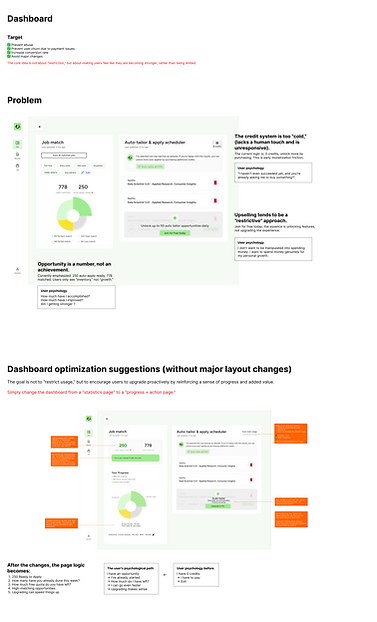

Understanding User Needs & Business Opportunities
To redesign the Hub around real user needs instead of assumptions, I created and distributed surveys to job seekers through multiple communities and organizations. The findings revealed users' most valuable features, common frustrations, and usage patterns, helping the team identify both growth opportunities and monetization strategies that informed later design decisions.

Design Strategy & Prioritization
With the research complete and priorities aligned, I redesigned the product step by step, focusing first on the highest-impact opportunities to improve conversion while minimizing development cost.
Improvement 1: Redesigning the Website for Higher Conversion
The first impression of the product was weak, making it difficult for new visitors to understand why they should try Blinkle. I reorganized the content hierarchy, simplified messaging, and improved the page layout so users could immediately grasp the value proposition. I also redesigned the Hero illustration to shift the narrative from showcasing isolated AI features to presenting Blinkle as an end-to-end AI job search workflow, making the product vision clearer and more compelling.

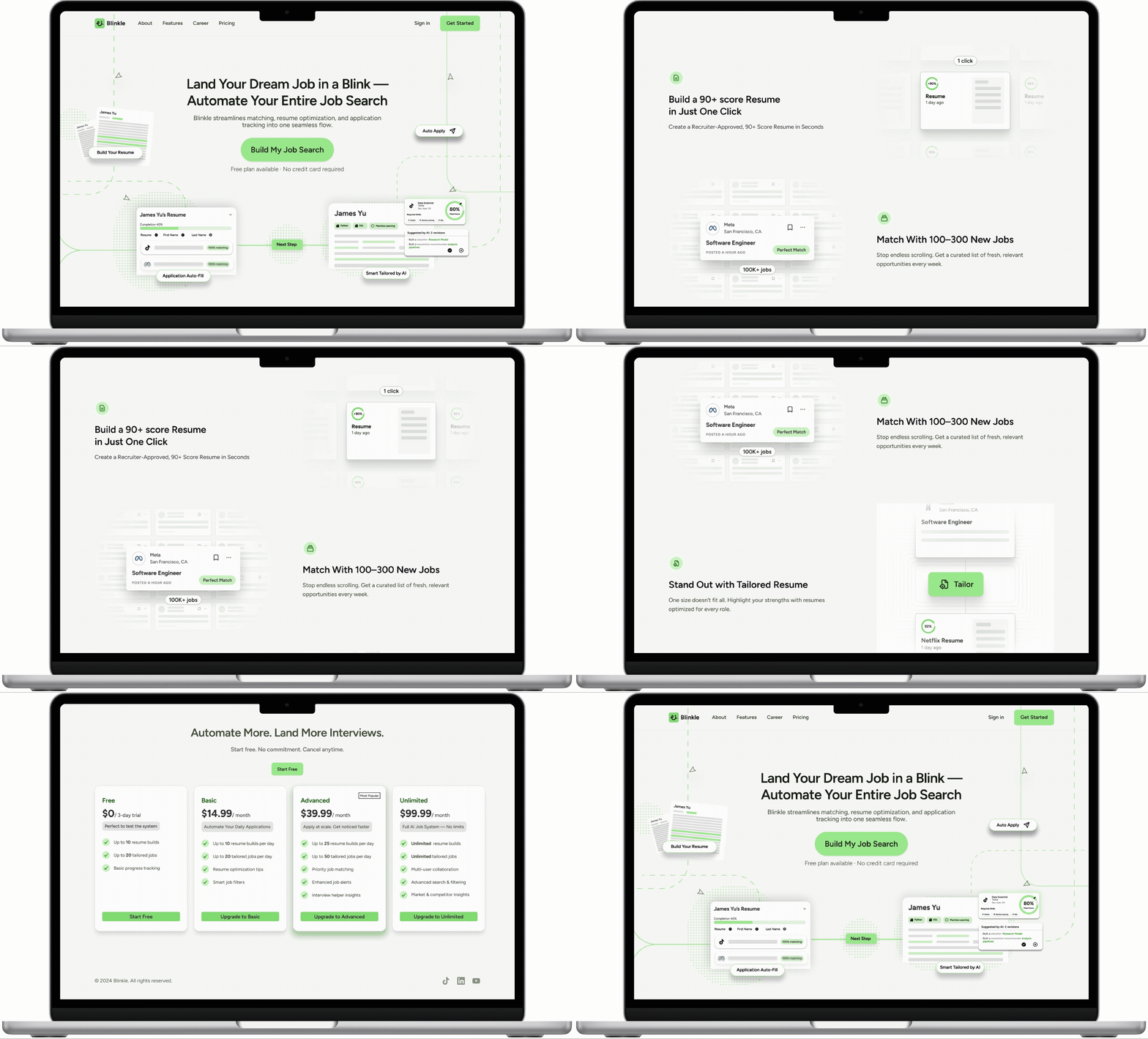
Improvement 2: Redesigning the Credit Economy
While mapping the onboarding experience, I found that the existing credit system contained inconsistent rules that confused users and complicated implementation for engineering and AI teams. I collaborated across functions to redesign the credit framework by balancing operational costs, market expectations, and conversion goals. After multiple iterations, we established a clear and scalable model that standardized credit consumption across AI-powered features and aligned the entire team around a single source of truth.


Improvement 3: Designing an Onboarding That Converts
Once the new credit model was defined, the next challenge became turning free users into paying customers. We introduced five free onboarding credits to let users experience AI-powered resume features, but carefully designed the flow so users could discover the product's value without generating a complete resume for free. This balanced user satisfaction with business sustainability while creating a natural upgrade path.


Improvement 4: Transforming the Dashboard into a Growth Hub
Research showed that users were often unsure what to focus on after entering the Hub. The existing dashboard lacked hierarchy, clear messaging, and actionable guidance. Through multiple design iterations, I rebuilt the information architecture to make users immediately understand their status and next steps. I also created different dashboard experiences based on subscription tiers and credit status, strategically surfacing upgrade opportunities while keeping the experience intuitive and unobtrusive.
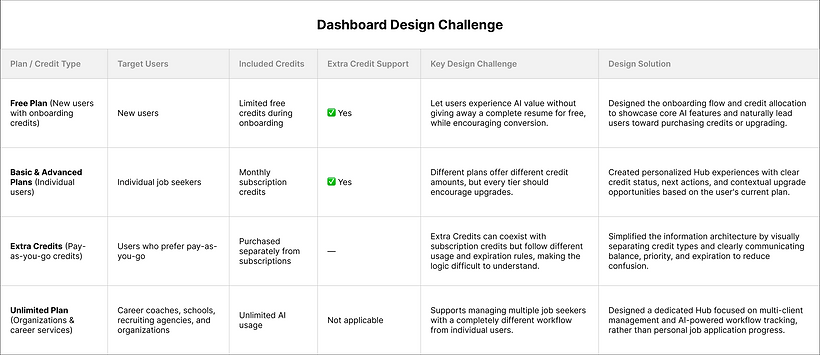
One of the biggest design challenges was translating a complex business model into a simple interface. The platform supported four subscription plans alongside Extra Credits, each with different usage rules and expiration logic. My role was to simplify these relationships into a clear interaction model that users could easily understand while naturally encouraging plan upgrades and credit purchases.

Validation Before Launch
Before launch, I partnered with engineering and AI teams for more than two months of continuous testing and iteration. By tracking issues through a shared bug list, validating edge cases, and refining both interfaces and workflows, we resolved numerous usability and logic problems before release, delivering a smoother and more reliable end-to-end experience.

Next Growth Opportunities
While the redesign significantly improved the product, I identified several opportunities for future growth. These include evolving AI from an assistant into a fully autonomous agent that handles applications automatically, simplifying onboarding even further to reduce friction and increase activation, and expanding the post-interview experience with AI coaching and third-party learning resources to create additional user value and new revenue opportunities.
